How AI Is Transforming BIM in 2026: Applications, Benefits, and the Future of AEC
Article by John Cooper Published on 15 Sep 2026

The AEC industry is going through a paradigm shift these days. The projects are getting complex and the clients are demanding faster project completion without increasing the project cost. The demands for maintaining the cost and time to achieve projects’ quality are exponentially growing. Building information modeling is one of the latest trends that have been implemented to digitally and intelligently execute the information. The latest technologies such as Artificial Intelligence (AI) could take the AEC industry to the next level and exponentially improve the BIM.
In 2026, AI (and BIM in general) in construction goes from novelty to everyday companion in the AEC workflow. The ability for AI to analyze, extrapolate, automate, and inform can be used in an ever-growing list of use cases and situations in the industry.
Understanding the AI-BIM Connection
BIM stands for Building Information Modeling which is digital representation of a building and its information including its systems and materials, quantities etc.
By implementing AI, one is able to make it intelligent. In other words, it offers an opportunity to not only observe and store the information in a model but also to be able to infer, detect, troubleshoot, compare and contrast etc.
Key Applications of AI in BIM
Generative Design and Optimization
I think generative design is one of the most compelling applications of AI in BIM. Instead of having a singular solution designed by a designer that will need to be massaged and refined, designers can define what their requirements are (spatial, structural, power, energy, cost, etc.) and have the system generate multiple options for the designer to explore.
This does not replace a designer but allows them to consider much more than one option, often leading to much more efficient designs at an early stage.
Smarter Clash Detection
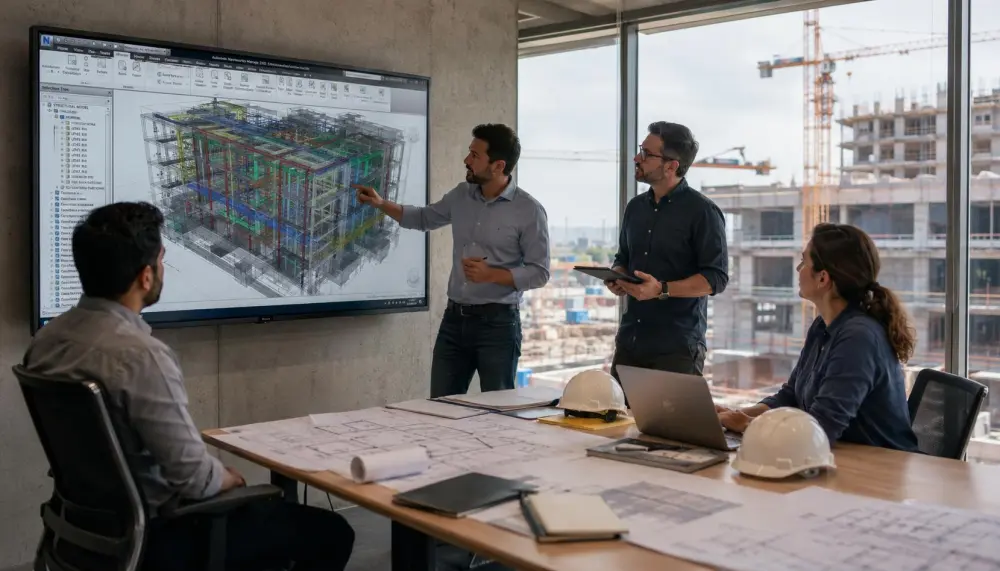
Clash detection is currently one of the leading aspects of the BIM coordination process. By using AI it becomes possible to optimize the process by making it more targeted. Intelligent coordination tools can be used to find relations in the detected clashes and prioritize them.
The coordination team has a lot of clashes to go through, and not all of them need to be addressed immediately. Therefore, it is important to prioritize those with the most impact on the project to make sure they get reviewed and resolved in time thus avoiding project delays and extra costs.
Predictive Project Management
Delays and cost overruns are rather a frequent occurrence in many spheres of human activity. The fact that this information can be utilized to identify patterns that could potentially be recognized by an AI is genius. The very idea of employing BIM, along with the additional time and project-specific data that would have to be inputted in order to come up with a solution that would prevent such issues from occurring in the future is brilliant!
It would have an immeasurable impact on project teamwork for similar projects because the impact of these delays and cost overruns on them would be lesser. Either they would not occur or, if they did, the project team would be much less surprised and better prepared for them.
Automated Quantities and Documentation
BIM (Building Information Modeling) models contain a wealth of information about the qualities of the objects that make up the building, allowing for a significant saving of time on the preparation of the quantity plan and documentation. In addition, the use of AIs can save time collecting information, managing, editing, and proofreading projects.
For people dealing with large-scale projects, even an addition of several hours to their working time could be very valuable, as it would enable them to complete more work and to focus on the tasks that require human expertise.
For people dealing with large-scale projects, even an addition of several hours to their working time could be very valuable, as it would enable them to complete more work and to focus on the tasks that require human expertise.
Construction Monitoring and Safety
AI could also be used outside the design office. Using cameras, drones, sensors, and computer vision we could get an idea of the situation at the site. With this information compared to the BIM model we could also get a better understanding of the situation than if we had not had this information.
This could allow us to find deviations, evaluate the site's conditions, and make sure the work is being done safely and orderly.
Benefits of AI-Driven BIM
The main benefit of combining AI and BIM is decision support. When Artificial Intelligence and BIM work together project teams can go beyond managing drawings, spreadsheets and other documents. They can use data to explore design options quickly and in greater detail. This leads to coordination across the entire project.
Using this technology has advantages. Teams can analyze design alternatives faster. Collaboration improves because everyone has access to the data. Potential risks can be identified in the process. Cost and time estimates become more accurate. There are design changes after the project starts. Materials are used efficiently. Facility management becomes more effective.
VR4BIM supports collaboration by creating model-based building information management processes. These processes bring together all information sources into one system. By linking AI and BIM the software helps share project information. This flow of data begins at the design and construction stages. It continues through the lifecycle of the building.
Challenges of AI Adoption
AI is not a solution. Putting an AI tool into a workflow does not automatically make a project AEC companies still deal with models, irregular data standards, separate software, problems with compatibility and a lack of people who have the technical skills. Data security and privacy should also be taken into account especially when project details are handled through systems.
There is also the issue of judgment. Architects, engineers, BIM managers and construction workers still need to check results and make decisions. AI is most effective, as a help tool that allows professionals to work quicker and understand project details clearly.
better. The quality of the outcomes depends mostly on the quality of the information that is used.
The Future of AI and BIM in AEC
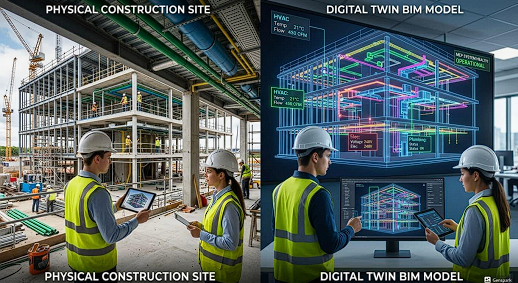
I see that the BIM will likely become part of an environment. BIM models might connect with sensors, drones, project management platforms, digital twins and other technologies to help information flow smoothly.
Digital twins stand out as powerful. When BIM data is combined with real-time data from buildings, owners and facility managers can keep track of how a building's performing. Owners and facility managers can spot maintenance issues early, boost energy efficiency and make choices after construction has finished.
Another promising idea is natural language interfaces. By digging through files or clicking through software menus a project professional could simply ask, "Which unresolved MEP clashes are affecting Level 5?" An intelligent system could then pull the information. Give a clear answer.
The aim is not to replace AEC professionals. The aim is to give AEC professionals tools, access to information and more time to focus on decisions that need human experience and judgment.
Conclusion
I see AI is not taking the place of BIM; it is making BIM smarter. In 2026 the blend of these technologies is helping the AEC industry shift from building digital models to using project information more effectively.
From design and clash coordination to predictive planning, construction monitoring and digital twins AI opens new doors across the building lifecycle. Companies that pair these tools with data, solid BIM processes and human knowledge will be better ready for the future.
The next phase of BIM is not about building a better model. It is about building a more connected method to design, build, operate and manage the places where people live and work.
Read more Blog posts


 Subscribe to our newsletter
