Why BIM for Theme Parks Is Essential for Modern Entertainment Developments
Article by John Cooper Published on 29 Jul 2026
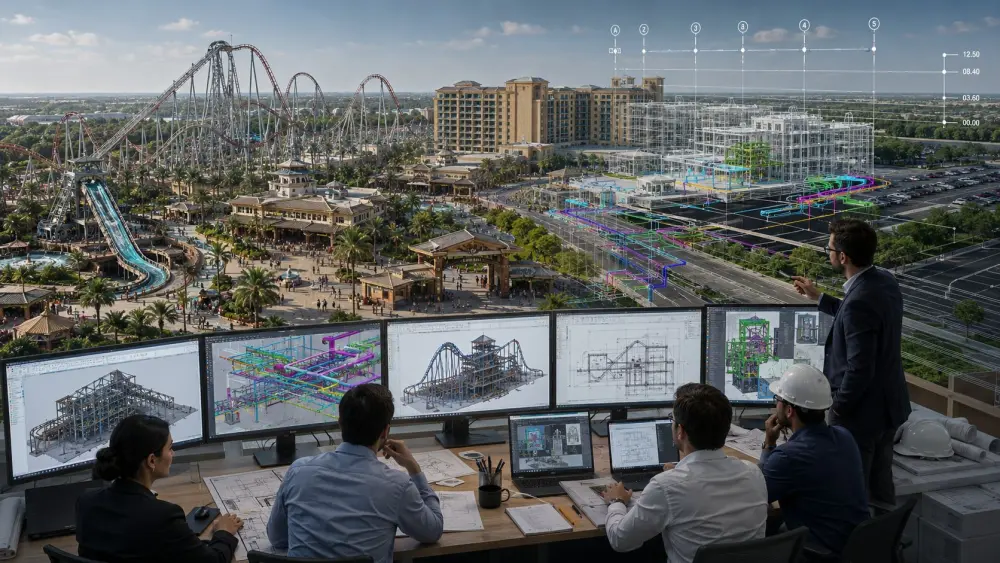
The theme park development sector has been undergoing changes year by year. Nowadays, theme parks are not only becoming more entertaining but also more immersive. Modern theme parks do not represent simple amusement parks. These are much more complex projects that include architecture, engineering, MEP design, landscape, water features, retailing, transportation, and many other aspects.
In order to develop such complex projects, it is necessary to use some sort of collaboration technique that would provide efficient communication between all parties involved in the process. And BIM for Theme Parks appears to be such a collaboration technique.
With the help of BIM, it is possible to collaborate on the same project throughout its entire lifecycle, from conceptual design to facility management.
Understanding Theme Park BIM
BIM stands for digital technologies that allow the creation of intelligent 3D models that contain not only geometrical but also non-geometrical information of project elements.
In the case of theme parks, BIM unites different specialized disciplines in one digital environment and includes such specializations as:
Architecture
Structural engineering
MEP (Mechanical, Electrical, and Plumbing systems)
Landscape architecture
Utility infrastructure
Transport infrastructure
Infrastructure for support structures of amusement park rides
Hospitality and retail services
Public infrastructure
Parking infrastructure
This approach differs from traditional drawing work because all people work in one updated model.
Overcoming the Obstacles Encountered in the Process of Building Theme Parks
One of the most complicated building projects is the construction of theme parks.
Some of the structures found within theme parks include:
Roller coaster tracks
Water rides
Theaters
Hotels
Food courts
Shopping areas
Underground utilities
Substations
HVAC systems
Walkways
Landscaping
Water features
Parking areas
All these structures require input from different fields of engineering.
In the absence of BIM, it is normal that there are design clashes that are not discovered until the completion of the project, resulting in delays and additional costs.
However, using BIM, all engineering disciplines can work together in a digital format even before the construction process begins.
BIM Coordination
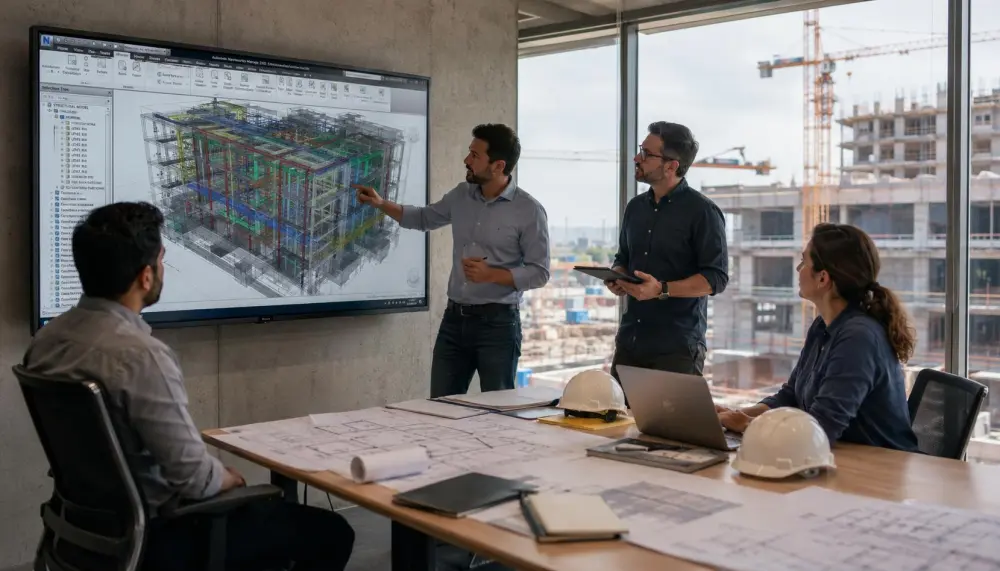
One other great benefit of the application of BIM technology in Theme Parks is that it facilitates coordination among different disciplines.
Architects, Structural Engineers, MEP designers, Landscape Architects, and Infrastructure Designers can work on the model together.
This will facilitate the project team in:
Detection of clashes
Coordination of utility lines
Verification of clearances for rides
Building layout improvement
Accessibility improvement
Avoiding design discrepancies
BIM technology facilitates increased efficiency in the implementation of the project through the elimination of rework.
Clash Detection Facilitates Solving Problems During the Construction Process
There are many mechanical, electrical, plumbing, and structural elements in Theme Parks.
Mechanical ducts may clash with beams.
Electrical lines may clash with plumbing systems.
Ride foundations may clash with utility pipes.
In case of poor coordination, the construction process will become expensive.
Through BIM software such as Autodesk Navisworks, the team can detect these clashes before the construction process.
Some of the benefits of clash detection include:
Construction process is not delayed
Cost of materials is saved
Improved contractor efficiency
Elimination of rework
Reduction in project costs
It is highly beneficial for large entertainment facilities.
Effective Construction Planning with 4D BIM
Construction planning and scheduling for theme parks require complex activities due to the existence of many contractors working at the same time across a vast area.
Construction planning and scheduling data are included in BIM models through 4D BIM technology.
Through 4D BIM, the project team can gain an understanding of the whole process as well as the interaction between various work packages.
Advantages of 4D BIM include:
Improved sequencing
Coordination among contractors
Improved construction planning
Reduced scheduling conflicts
Faster project delivery
The management is provided with an option to gain insight into the construction process even before its actual implementation.
Cost Estimation Through 5D BIM
Budget control is vital for the project because the sums of money invested in these projects can reach hundreds of millions of dollars.
Budget integration with BIM models is achieved by using 5D BIM technology.
Since all the elements in the model contain information about dimensions, it becomes more precise to perform quantity take-offs.
Project owners will be able to:
Estimate costs earlier
Control budget changes
Avoid quantity mistakes
Improve procurement plans
Invest effectively
Construction Safety Advancements Through BIM
Theme park construction involves the use of heavy machinery, steel erection, excavation work, utility system installation, and infrastructure development.
The use of BIM helps increase safety levels at construction sites by creating visualizations of potential risks prior to construction.
Preparations for safety include:
Equipment transportation
Crane placement
Temporary constructions
Emergency access routes
Worker movement
Dangerous operations planning
Virtual planning leads to increased safety at construction sites.
Promoting Sustainable Development of Theme Parks
Sustainability is one of the factors considered during current entertainment destination development.
BIM allows sustainable design of buildings since it offers opportunities to conduct analysis of:
Structure orientation
Sunlight exposure
Energy consumption
Water management
HVAC system efficiency
Material selection
Carbon emissions
Waste management
All these analyses help in designing sustainable facilities that are cheaper to operate.
Effective Collaboration of International Teams
Consulting engineers and contractors from various countries are often required for the development of large theme parks.
The use of cloud-based BIM allows collaboration of all participants within the same virtual environment.
It means that there will be improved:
Communication
Documentation management
Version control
Approvals
Design reviews
Decision-making
Improving Visitor Experience Through Good Design
Theme parks depend heavily on visitor experience.
Through BIM technology, designers will be able to enhance visitor flow before the start of the construction process.
Among the considerations are the following:
Queue design
Crowd flow
Emergency exit routes
Accessibility
Parking area connections
Location of retail stores
Restaurant locations
Signage
All these aspects will improve the visitor experience.
Facility Management After the Construction Phase
BIM technology continues to play a significant role even after the construction phase.
Some of the information that can be found in each BIM model includes:
Equipment specifications
Manufacturer information
Maintenance information
Warranty information
Replacement information
Asset location
Future-Proofing Theme Parks Through Digital Twin Technology
Due to the development of technology, many entertainment companies have started using Digital Twin technology.
Digital Twin technology is an extension of BIM technology that includes live data and smart building technology.
It allows operators to monitor:
Ride efficiency
Energy usage
Occupancy management
Environmental assessment
Equipment maintenance
Predictive maintenance planning
BIM along with Digital Twin technology enables informed decision-making.
Reasons Why We Have Chosen to Adopt VR4BIM for Theme Parks BIM Services
Theme park design needs both proficiency in modeling and great expertise in interdisciplinary coordination, constructability, project management, and BIM standards around the world.
VR4BIM offers comprehensive BIM services that are intended specifically for complicated entertainment projects. Whatever it is, architectural, structural, MEP modeling, BIM coordination, clash detection, 4D scheduling, or construction documentation, VR4BIM has everything you may need.
Using the latest technologies and project management approaches, VR4BIM helps you create excellent entertainment facilities.

 Subscribe to our newsletter
